AIF vs PMS India 2026: Minimum Investment, Tax, Liquidity & Who Should Choose What
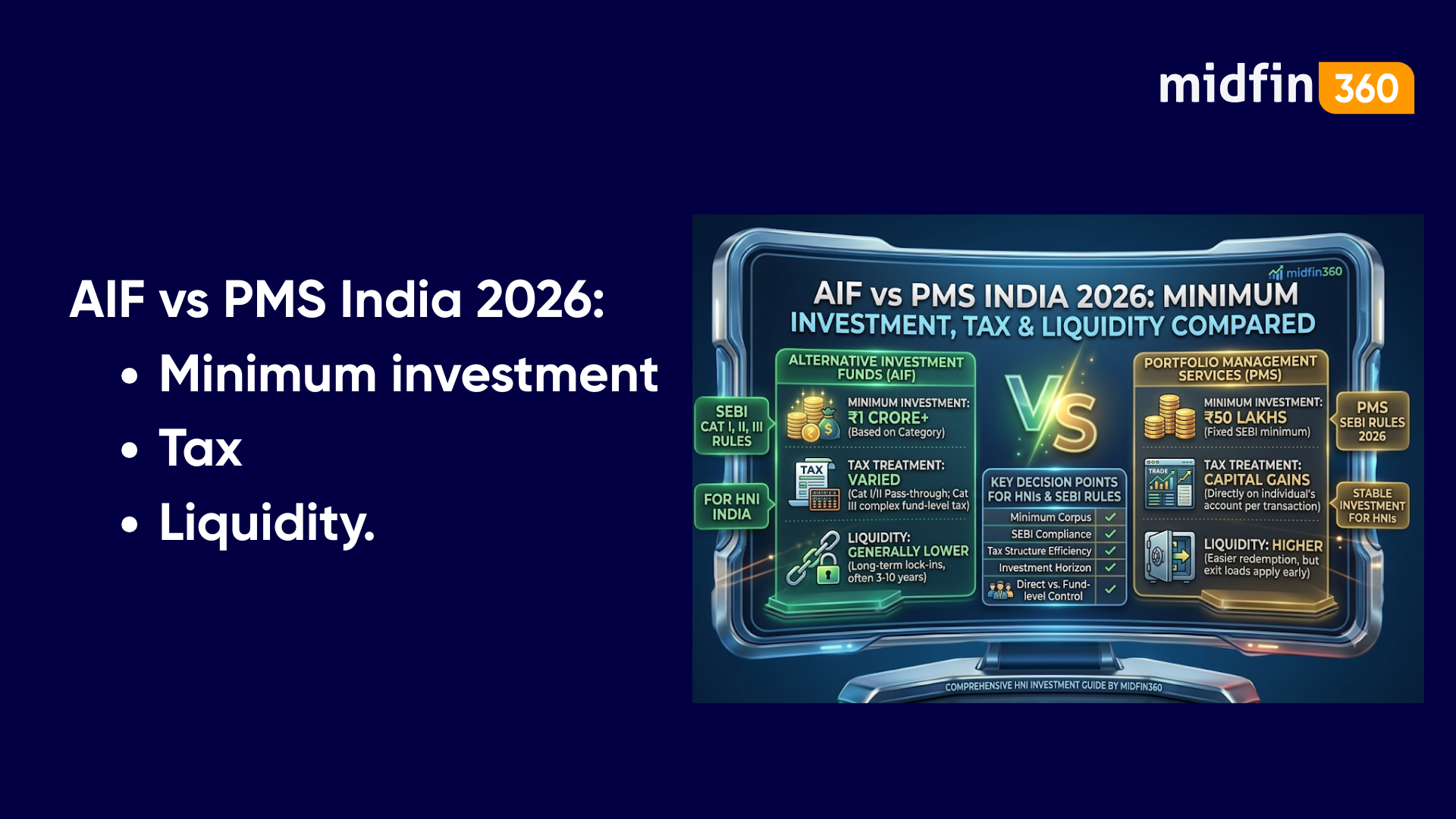
For standard retail investors, a robust portfolio of regular mutual funds built through disciplined SIPs is usually the perfect engine for wealth creation. However, as your corpus grows into the multi-crore bracket in 2026, your financial requirements evolve. You begin seeking niche opportunities, sophisticated hedging strategies, and exposure to unlisted companies. This is where the AIF vs PMS India conversation begins.
When evaluating the best investment for HNI India 2026, two major regulated structures dominate the landscape: the Alternative Investment Fund vs Portfolio Management Service. While both cater to affluent investors, they operate on vastly different legal, structural, and taxation frameworks.
In this comprehensive guide, we will break down the crucial differences between the two, explore the nuances of an AIF minimum investment India compared to a PMS minimum investment India, and demonstrate how incorporating sophisticated assets through a guided platform like midfin360 can transform your wealth trajectory.
What is an Alternative Investment Fund (AIF)?
An Alternative Investment Fund (AIF) is a privately pooled investment vehicle established or incorporated in India. These funds collect capital from sophisticated Indian and foreign investors to invest it by a defined investment policy for the benefit of its investors.
Governed strictly by the SEBI AIF regulations 2012, an AIF pooled investment vehicle pools money much like a mutual fund, but it targets highly complex, alternative asset classes that standard retail funds cannot touch. The regulator has capped the maximum number of investors per scheme to a strict AIF 1000 investor limit SEBI framework.
To cater to different risk profiles, SEBI classifies these into three distinct categories:
- AIF Category I India: These funds invest in start-ups, early-stage ventures, social ventures, and infrastructure. This is the domain of the AIF Category I venture capital India sector. Notably, an AIF angel fund ₹25 lakh sub-category exists here for early-stage startup funding.
- AIF Category II India: Funds that do not fall in Category I or III and do not undertake leverage or borrowing (other than to meet day-to-day operational requirements). This includes AIF Category II private equity India, real estate funds, and the increasingly popular AIF private credit India funds.
- AIF Category III India: These funds employ complex trading strategies and may employ leverage. This is where you find the equivalent of an AIF Category III hedge fund India, which aims for short-term returns through derivatives and diverse market bets.
Before diving into these sophisticated pools, it is vital to ensure you have a solid foundation. We highly recommend reading our guide on building a diversified core before adding AIF/PMS using regular mutual funds.
What is a Portfolio Management Service (PMS)?
Unlike the pooled structure of an AIF, a Portfolio Management Service (PMS) offers customized investment portfolios in equity or debt. Governed by the SEBI Portfolio Managers Regulations 2020, a PMS does not pool your money into a single fund.
Instead, the portfolio manager creates a PMS segregated portfolio demat account in your name. You hold the actual shares or securities directly in your dematerialized (demat) account.
A PMS typically operates in two primary modes:
- PMS Discretionary: The portfolio manager makes all investment decisions independently, buying and selling securities without needing your prior approval for every trade.
- PMS Non-Discretionary / Advisory: The manager suggests investment ideas, but the final decision and execution rest entirely with you. You can learn more about these distinctions through discretionary vs non-discretionary investment principles.
Because a PMS primarily deals in listed equities, understanding your own risk appetite and market cap exposure is crucial before committing capital to a focused PMS strategy.
AIF vs PMS 2026: Key Differences Explained
To determine AIF vs PMS which is better India, we must compare them across several critical parameters.
1. Minimum Investment Thresholds
The entry barriers for these products immediately define their target audience.
- PMS Minimum Investment India: As per current SEBI norms, the minimum ticket size to enter a Portfolio Management Service is ₹50 Lakhs.
- AIF Minimum Investment India: To invest in an AIF, the regulatory minimum is set much higher at ₹1 Crore (with the exception of "Angel Funds" under Category I, which have a minimum limit of ₹25 Lakhs).
This high threshold for AIFs ensures that only a qualified, accredited investor India SEBI participates in these high-risk, low-liquidity environments.
2. Capital Commitment vs Deployment
How you pay your investment amount differs significantly.
- PMS: You deploy your ₹50 Lakhs (or more) upfront. The manager immediately takes control of this capital to buy securities in your demat account.
- AIF: AIFs usually operate on a drawdown model, emphasizing AIF commitment vs investment India. You "commit" ₹1 Crore, but you don't pay it all at once. The fund manager issues capital calls over several years as and when they find viable private equity or venture capital opportunities.
3. Structure and Ownership Rights
- PMS: Offers PMS direct stock ownership. You own the shares, corporate actions (like dividends and voting rights) belong to you, and your portfolio can theoretically be customized.
- AIF: You own "units" of the fund, much like a mutual fund. You do not own the underlying start-up equity or private credit bonds directly; the trust or company managing the AIF owns them.
4. Liquidity and Lock-In Periods
When comparing PMS liquidity vs AIF liquidity, the contrasts are stark.
- PMS: Generally highly liquid because the underlying assets are publicly traded stocks. While there might be exit loads if you withdraw early (typically within the first 1-3 years), you can liquidate a PMS relatively quickly.
- AIF: AIFs are notoriously illiquid. An AIF lock-in period India for Category I and II funds is highly restrictive, often lasting 3 to 7 years, or even up to 10 years depending on the fund lifecycle. Your capital is locked while the underlying startups or real estate projects mature.
For investors seeking high liquidity, sticking to regular mutual funds or exploring alternative tax-efficient investment avenues is often a safer bet before locking capital in an AIF.
5. Fee Structures
Both vehicles cater to HNIs and carry premium fee models.
- PMS: Usually charges a fixed management fee (1-2.5%) plus a profit-sharing component. This profit share is often subject to a high water mark fee PMS condition, meaning the manager only gets a performance fee if the portfolio value exceeds its previous highest peak. You can find detailed explanations of a high-water mark on standard financial glossaries.
- AIF: Typically follows the global "2 and 20" model: a 2% fixed management fee on committed capital and an AIF performance fees India hurdle rate (often 20% of the profits above a pre-defined benchmark return).
AIF vs PMS Tax Efficiency: How Are They Taxed?
Taxation is often the deciding factor in the AIF vs PMS tax efficiency debate. The Income Tax Department of India treats these structures very differently.
PMS Taxation India
Because a PMS is a segregated account where you own the stocks directly, PMS taxation India capital gains rules apply exactly as they do to direct equity investing.
- Every single time the portfolio manager sells a stock to rebalance your portfolio, it triggers a tax event for you.
- Depending on the holding period of that specific stock, you will be liable for Short Term Capital Gains (STCG) or Long Term Capital Gains (LTCG).
This constant buying and selling can make a PMS highly tax-inefficient compared to regular mutual funds (where internal rebalancing is tax-free). To understand how to manage tax across structures, review our guide on how to choose tax-efficient funds.
AIF Taxation India
AIF taxation depends entirely on the category.
- Category I & II: These funds enjoy AIF pass-through taxation India. This pass-through entity status means the fund itself does not pay tax. The income or capital gains generated by the fund are passed directly to the investor and taxed at the investor's applicable slab rate or capital gains rate, just as if the investor had made the investment directly.
- Category III: These do not have pass-through status. The tax is deducted at the fund level itself (often at the maximum marginal rate), and the investor receives the net returns post-tax.
Navigating the tax implications when exiting investment structures requires careful planning with a chartered accountant and a certified distributor.
Best Investment for HNI India 2026: Who Should Choose What?
As ultra HNI investment options India expand, choosing between an AIF and a PMS boils down to your specific goals, liquidity needs, and risk tolerance.
You Should Choose a PMS If:
- You have a minimum of ₹50 Lakhs to invest upfront.
- You want direct ownership of listed equities in your demat account.
- You desire high liquidity and the ability to exit (subject to exit loads) if needed.
- You want a customized, concentrated portfolio of 15-25 high-conviction stocks.
You Should Choose an AIF If:
- You have a minimum of ₹1 Crore in commit capital.
- You are looking for true diversification away from the listed stock market into venture capital, private equity, distressed assets, or private credit.
- You have a long investment horizon (5 to 10 years) and do not need immediate liquidity.
- You are managing a large family office investment India strategy and need uncorrelated assets.
For investors who find the ₹50L or ₹1Cr limits too steep, or who want a bridge between mutual funds and these advanced products, understanding how SIF sits between mutual funds and PMS is a vital next step.
The midfin360 Advantage: Navigating HNI Investments
Transitioning from standard retail investments to complex AIF structures is not a journey you should undertake blindly. Furthermore, before committing massive capital to illiquid assets, you must ensure your core foundational wealth is secure and optimized.
This is precisely where midfin360 serves as your ultimate wealth partner. While we do not operate as a direct plan platform, we firmly believe in the power of guided wealth creation. By offering regular mutual funds distributed under a valid ARN, we provide the ongoing distributor guidance and portfolio reviews that HNIs desperately need.
Here is how midfin360 elevates your investment experience:
- Core Foundation Building: Before locking ₹1 Crore in an AIF, you must exhaust your basic tax-saving limits. We help you identify tax-saving options before stepping into PMS or AIF through regular ELSS funds and NPS Tier I & II via our seamless app integration.
- AIF Discovery and Listing: For our HNI clients, the midfin360 platform provides discovery and listing for AIF Category I, II, and III. We help you navigate the complex paperwork and commitment schedules.
- Expert Distributor Guidance: We help you in evaluating fund manager track record and assessing your portfolio’s true XIRR to ensure any AIF addition genuinely complements your existing mutual fund holdings.
- Risk Assessment: Transitioning to alternative assets requires deep risk profiling. We emphasize understanding risk ratings before committing large capital.
- Regulated Trust: Operating strictly under the purview of the Securities and Exchange Board of India (SEBI) and AMFI, we remind our users of the importance of regulated intermediaries in every transaction.
Whether you are looking to set up a robust SIP in a regular flexi-cap mutual fund or explore the specialized avenues of an AIF, having a distributor who understands your holistic financial picture is your greatest asset.
Frequently Asked Questions (FAQs)
What is the minimum investment for an AIF in India? The AIF minimum investment India limit is set by SEBI at ₹1 Crore for standard Category I, II, and III funds. However, for "Angel Funds" specifically targeted at early-stage startups under Category I, the minimum investment is ₹25 Lakhs.
What is the minimum investment for a PMS in India? The PMS minimum investment India limit was revised by SEBI to ₹50 Lakhs (up from the previous ₹25 Lakhs limit) to ensure only investors with adequate risk appetite participate in these concentrated portfolios.
Which is better: AIF or PMS? Neither is universally "better." If you want a concentrated portfolio of listed stocks with high liquidity and direct ownership, a PMS is ideal. If you want exposure to unlisted start-ups, real estate, or private credit and can afford a long lock-in period, an AIF is the superior choice.
How is a PMS taxed in India? Because a PMS is a segregated account of direct equities, it is taxed just like regular stock trading. Every time the portfolio manager sells a stock for a profit, you are liable for Short Term Capital Gains (STCG) or Long Term Capital Gains (LTCG) depending on the holding period.
Does an AIF have a lock-in period? Yes, Category I and II AIFs are close-ended funds and come with a mandatory AIF lock-in period India, which typically ranges from 3 years to 10 years, making them highly illiquid compared to a PMS or mutual funds.
What is AIF pass-through taxation? Pass-through taxation means the AIF (specifically Category I and II) does not pay corporate tax on its earnings. Instead, the tax liability "passes through" to the individual investors, who pay tax based on their respective income tax slabs or capital gains rates.
Can I invest in both AIF and Mutual Funds? Absolutely. In fact, standard financial planning dictates that you should build a highly liquid, diversified core portfolio using regular mutual funds first. An AIF should only represent a smaller, high-risk satellite portion of a much larger HNI portfolio.
Is a demat account required for an AIF? While you need a demat account for a PMS (because you hold the stocks directly), an AIF pools your money and issues units to you. While these units can be held in demat form, the structural operation is closer to a mutual fund than direct stock trading.
Conclusion: Elevate Your Wealth Strategy with Expert Guidance
The AIF vs PMS India debate represents a fantastic problem to have—it means you have successfully built substantial wealth and are now looking for advanced avenues for growth. Understanding the stark differences in the AIF minimum investment India, the varying tax structures, and the stringent liquidity lock-ins will dictate which vehicle aligns with your family's financial vision.
However, moving into the realm of ultra HNI investment options should never be a DIY experiment. Navigating performance fees, pass-through taxation, and capital commitments requires a steady hand and a holistic view of your entire portfolio. A strong core of regular mutual funds, managed with expert distributor guidance, remains the ultimate foundation upon which all alternative investments should be built.
Ready to explore sophisticated wealth creation backed by expert guidance? Don't navigate the complex world of high-net-worth investing alone. Download the midfin360 app today! Build your core portfolio with guided SIPs in regular mutual funds, effortlessly track your consolidated XIRR, and let our registered distributors guide you through exclusive AIF discovery and holistic financial planning.
Disclaimer: midfin360 is an AMFI-registered Mutual Fund Distributor (ARN-306591). Mutual Fund and Alternative Investment Fund (AIF) investments are subject to market risks, read all scheme related documents carefully. The information provided in this blog is for educational purposes only and does not constitute personalized financial, legal, or tax advice. Past performance is not indicative of future returns. Please consult your financial advisor before making any investment decisions.
Manage all from your mobile
Take charge of your finances seamlessly — only on the Midfin360 app